

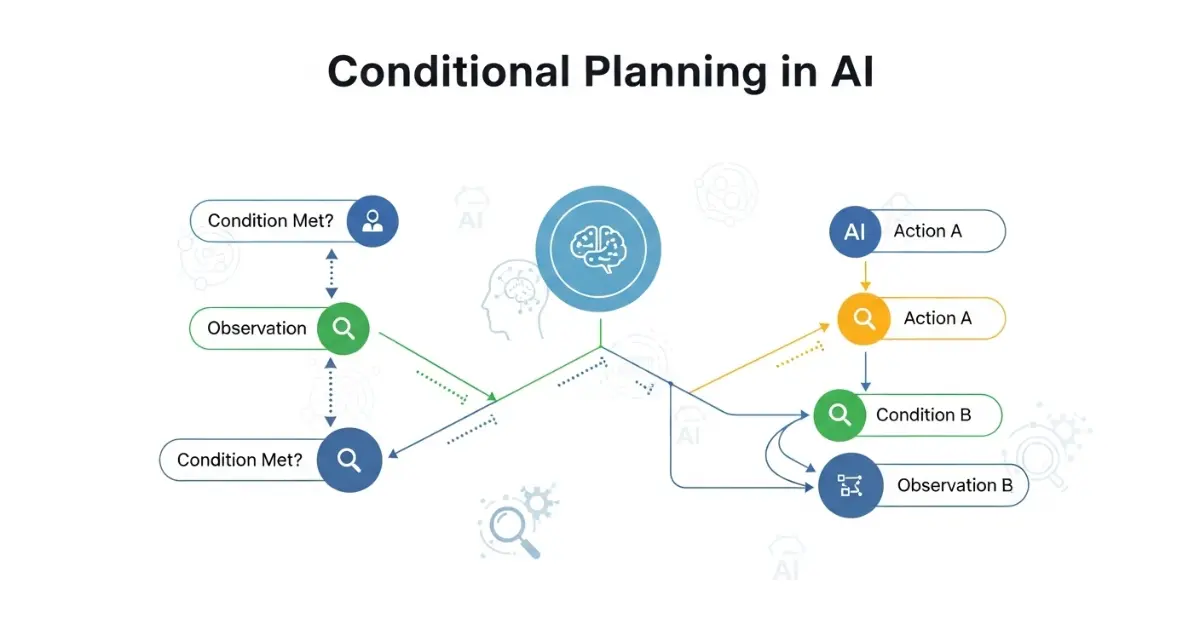
Conditional planning in artificial intelligence is a method used to handle uncertainty and multiple possibilities. Today, many smart systems, like autonomous robots and self-driving cars, use conditional plans in AI. They make decisions based on observations, sensors, and runtime changes. This type of planning ensures robust conditional plans and goal achievement under uncertainty.
What Is Conditional Planning in Artificial Intelligence?
Conditional planning in artificial intelligence means making a smart plan that can change when things are not certain. In many real situations, a system cannot know everything before it starts. A simple fixed plan will fail when things change. Conditional planning AI solves this problem by creating plans with more than one possible path.
Importance of Planning in AI
Planning is an important part of artificial intelligence. It helps smart systems think ahead and make better choices. When an AI plans its steps, it knows what to do next to reach its goals. Planning allows machines to work even when things change or new information arrives. With good planning, AI becomes more reliable, flexible, and useful in real life.
Here are complete details key points on conditional planning in AI easy for students.
- Helps AI choose the right actions to reach goals.
- Allows systems to handle change and uncertainty.
- Improves decision-making in smart machines.
- Reduces mistakes by thinking ahead.
- Supports complex tasks in real-world situations.
- Makes AI more flexible with many possible outcomes.
- Enables adaptive and responsive behavior.
- Strengthens reliability and performance of AI.
Applications of Conditional Planning in Artificial Intelligence
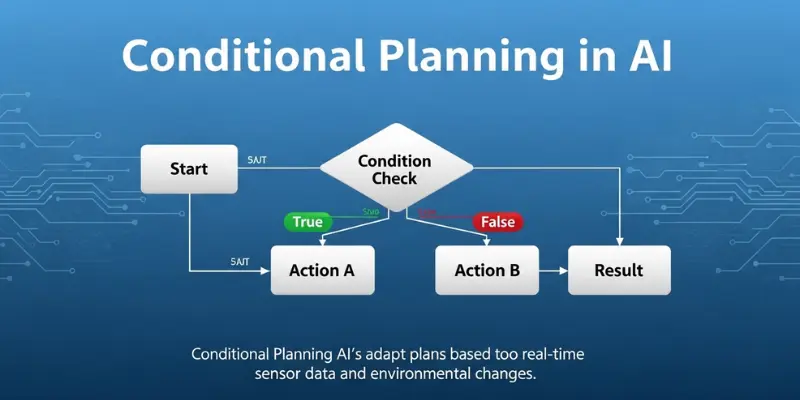
Conditional planning in artificial intelligence helps smart systems make decisions when things change or are not certain. It is not like simple plans that follow one path. Instead, it builds multiple paths based on different results, sensor data, and new information. This method helps AI adapt to real-life problems, respond to new data in real time, and reach goals even when the world around it is not fixed. Conditional planning AI is useful in many fields where a system must act safely, respond quickly, and make the best choice under uncertainty.
Here are complete details Applications of conditional planning in AI easy for students.
- Autonomous Vehicle Decision Making
- Robot Navigation in Unknown Areas
- Smart Home Automation Responses
- Real-Time Traffic Management Systems
- Disaster Response and Rescue Robots
- Dynamic Task Scheduling in Factories
- Interactive Game AI Behavior
- Adaptive Customer Support Bots
Types of Conditional Planning in Artificial Intelligence
Conditional planning in artificial intelligence helps machines make smart choices when the future is not certain. In real life, situations can change, sensors may give new data, and results may vary. Conditional planning AI lets a system prepare for different possibilities and react as things change. It uses simple if‑then logic and branching paths to reach goals even when outcomes are not fixed. This type of planning is useful when there are many possible outcomes and the system must update its plan based on what it observes or senses.
Here are complete details about types of conditional planning in AI easy for students.
- Branching Plans AI
- Sensing and Observation Planning
- Probabilistic Conditional Planning
- Belief‑State Planning
- Reactive Conditional Planning
- Adaptive Planning AI
- Policy‑Based Planning AI
- Observation‑Based Planning
1. Branching Plans AI
Branching plans AI are plans that have multiple paths depending on different outcomes. They allow AI to make decisions at each step based on the situation. If one path fails, another can be followed. This helps systems achieve goals even in uncertain environments. Branching plans are widely used in autonomous systems and robotics.
2. Sensing and Observation Planning
Sensing and observation planning uses data from sensors or observations to guide AI decisions. The system adapts its plan based on what it senses in real time. This type of planning is useful when the environment is dynamic. It helps AI respond accurately to unexpected changes. Many robots and smart devices rely on this approach.
3. Probabilistic Conditional Planning
Probabilistic conditional planning considers different outcomes with associated probabilities. AI evaluates which path is most likely to succeed. This type of planning is helpful when actions may have uncertain results. It improves decision-making under risk. Self-driving cars often use probabilistic planning to predict traffic or obstacles.
4. Belief‑State Planning
Belief-state planning tracks what the AI believes about the world at each step. Since not all information is always available, the system maintains a set of possible states. Plans are updated as new data comes in. This approach helps AI make informed decisions even with incomplete knowledge. It is used in complex and partially observable environments.
5. Reactive Conditional Planning
Reactive conditional planning allows AI to respond instantly to changes in its environment. Plans do not need to be fully predefined. The system reacts to events as they happen. This approach is fast and effective for real-time operations. Robots and drones often use reactive planning for navigation and obstacle avoidance.
6. Adaptive Planning AI
Adaptive planning AI can modify its plan while it is running. The system learns from changes and adjusts actions accordingly. This ensures goals are still met even when unexpected situations occur. Adaptive planning improves reliability in dynamic environments. Many AI applications, including autonomous agents, rely on adaptive planning.
7. Policy‑Based Planning AI
Policy-based planning AI uses rules or policies to decide actions based on the current state. Instead of planning every step in detail, the AI follows guidelines. This makes it efficient in large or uncertain environments. Policies help maintain flexibility while ensuring desired outcomes. It is common in intelligent agents and automated systems.
8. Observation‑Based Planning
Observation-based planning depends on monitoring the environment during execution. AI updates its plan using new observations to stay on track. This type ensures that actions remain relevant to the current situation. It is particularly useful when the world is unpredictable. Observation-based planning is key for adaptive and reactive systems.
Difference Between Deterministic and Conditional Planning in Artificial Intelligence
Deterministic planning in artificial intelligence
Deterministic planning in artificial intelligence works when the future is certain. In this type, the system knows exactly what will happen after each action. It is like following a fixed path. The plan stays the same no matter what. This works well when there are no surprises or unknown events.
Conditional planning in artificial intelligence
Conditional planning in artificial intelligence is different. It works when things can change and the future is not fixed. In this type, the system prepares for multiple results and chooses the best path based on what happens. Conditional planning AI uses sensing, observations, and branching paths. It helps smart machines reach goals even when outcomes are not known ahead of time.
Challenges in AI Conditional Planning
AI planning helps machines make smart decisions, but it also comes with challenges. Planning systems must deal with uncertainty, incomplete information, and changing environments. Some plans may fail if unexpected events happen, and handling multiple possible outcomes can be complex. These challenges make AI planning a difficult but important task for real-world applications.
- Uncertainty Handling
- Incomplete Information
- Complexity of Conditional Plans
- Real-Time Adaptation
- Plan Verification and Monitoring
FAQs about Conditional Planning in Artificial Intelligence
What is conditional planning in AI?
Conditional planning in AI is a way for systems to make decisions when outcomes are uncertain. It uses branching paths and if-then logic to handle different possibilities.
How is conditional planning different from deterministic planning?
Deterministic planning follows a single fixed path, while conditional planning considers multiple possible outcomes and adapts accordingly.
What is the role of sensing in conditional planning?
Sensing allows AI to gather real-time information. Conditional planning uses this data to adjust plans and make better decisions.
What are branching plans in AI?
Branching plans are structures that allow AI to follow different paths based on results or observations. Each branch represents a possible decision.
What is belief-state planning?
Belief-state planning tracks what the AI believes about the world, especially when information is incomplete. The plan updates as new information arrives.
How does adaptive planning AI work?
Adaptive planning AI changes its plan during execution to handle unexpected situations, goals are still achieved.
What is the difference between conformant and contingent planning?
Conformant planning works without new observations, while contingent planning updates plans using sensing and observations during execution.
Where is conditional planning used in real life?
Conditional planning is used in autonomous robots, self-driving cars, drones, smart assistants, and any AI system that needs to adapt to changing environments.
Conclusion
Conditional planning in artificial intelligence helps systems make smart decisions in uncertain and changing environments. By using branching plans, sensing, and adaptive strategies, AI can handle multiple outcomes and achieve goals reliably. This approach makes machines smarter, flexible, and ready for real-world challenges.
