

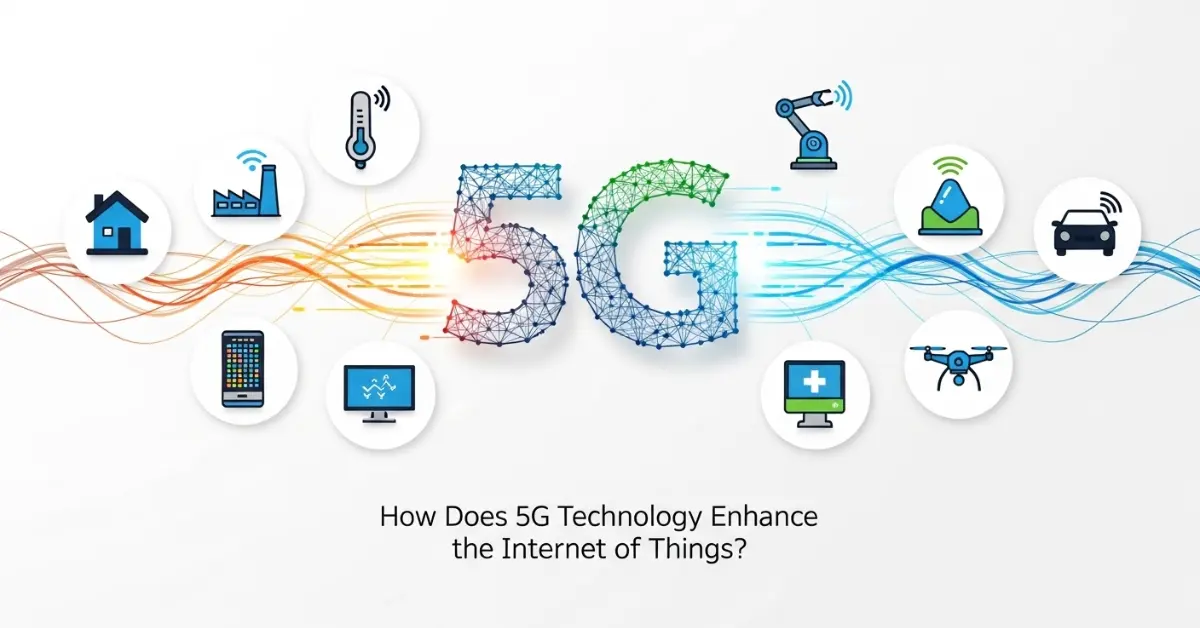
Did you know that 5G networks can be up to 100 times faster than 4G? This speed is changing the way smart devices work. With faster connections, more devices can communicate at the same time without delays. That is why 5G is helping the Internet of Things work better, making homes, cities, and factories smarter and more efficient. Here is complete information about how 5G technology enhances the Internet of Things for beginner students.
What is 5G Technology?
5G technology is the fifth generation of mobile network technology. It is the newest way for phones, tablets, and smart machines to connect to the internet. 5G is faster and stronger than older networks like 4G. It can send and receive data much quicker and with less delay than before. 5G also allows more devices to connect at the same time without slowing down.
5 Examples of 5G technology
- Faster Mobile Internet
- Smart Homes
- Self-Driving Cars
- Remote Healthcare
- Smart Cities
What is the Internet of Things (IoT)?
The Internet of Things, or IoT, means that many everyday things can connect to the internet and talk to each other. These things use small parts like sensors, software, and tech to collect and share information. They can send data and receive instructions without a person touching them. This makes the things work in a smart way and help people do tasks easily.
5 Examples of Internet of Things (IoT)
- Smart Home Devices
- Wearable Devices
- Smart Cars
- Industrial Sensors
- Smart Appliances
Fundamental IoT Protocols
Fundamental IoT protocols are the basic rules that allow smart devices to communicate with each other. They tell devices how to send, receive, and share data over a network. These protocols make sure that devices work together smoothly and exchange information in a fast and organized way. Here is an explanation of fundamental IoT protocols in detail for students.
- MQTT (Message Queuing Telemetry Transport): Fast and lightweight for small devices.
- HTTP (Hypertext Transfer Protocol): Helps devices send and receive data over the internet.
- HTTPS (Hypertext Transfer Protocol Secure): Secure version of HTTP for safe communication.
- CoAP (Constrained Application Protocol): Made for low-power and low-memory devices.
- AMQP (Advanced Message Queuing Protocol): Reliable protocol for messaging between devices.
- DDS (Data Distribution Service): For real-time data exchange between devices.
- XMPP (Extensible Messaging and Presence Protocol): Used for messaging and notifications.
- LoRaWAN (Long Range Wide Area Network): For long-distance wireless communication with low energy.
- Zigbee: Short-range, low-power wireless protocol for home and industrial devices.
- Z-Wave: Similar to Zigbee, used for smart home devices.
- Bluetooth / Bluetooth Low Energy (BLE): Wireless communication for nearby devices with low power.
- Wi-Fi: Wireless connection for internet-enabled devices.
- 6LoWPAN (IPv6 over Low-Power Wireless Personal Area Networks): Helps small devices connect using IPv6.
- Thread: Low-power, secure mesh network for smart home devices.
- NFC (Near Field Communication): Short-range communication for payments or data exchange.
5G: Cellular IoT Connectivity Protocols
5G is the newest mobile network. It helps many IoT devices connect to the internet and work well. Cellular IoT connectivity protocols are the rules and methods that devices use to connect over 5G. These rules help devices send data fast, stay connected, and save power. Here is an explanation of 5 Key 5G IoT Connectivity Protocols in detail for students.
5 Key 5G IoT Connectivity Protocols
- Faster Data Transfer: 5G lets devices send and receive information quickly. This helps smart systems work in real time.
- Low Latency (Little Delay): 5G reduces delay between devices and the network. This means devices respond faster.
- Massive Device Support: 5G can connect many IoT devices at the same time. This is good for smart cities and large systems.
- Reliable Network: 5G keeps devices connected without frequent breaks. This makes IoT systems more stable.
- Energy‑Efficient Communication: Many 5G IoT protocols use methods that help devices save battery power. This is important for devices that run for long time.
5G RedCap for IoT
5G RedCap means 5G Reduced Capability. It is a simpler and lower‑cost form of 5G made for Internet of Things (IoT) devices. RedCap gives enough speed and power saving for many smart devices. This makes devices cheaper and more energy efficient. RedCap still runs on 5G networks and uses the same core system, but it does not need all the high‑end features of full 5G. Here is an explanation of 5 Key 5G RedCap in detail for students.
5 Key 5G RedCap
- Balanced speed: It gives faster data than many older IoT links like LTE Cat‑1 and NB‑IoT, but not as fast as full 5G.
- Lower cost: Devices with RedCap need less complex parts, so they cost less.
- Better battery life: RedCap saves energy, so batteries last longer in smart wearables and sensors.
- Simple design: It uses narrow bandwidth and fewer antennas, which makes modules smaller and easier to build.
- Still true 5G: Devices stay on 5G networks and enjoy 5G benefits like lower delays and more reliable connections.
Applications of 5G‑Enabled IoT
5G‑enabled IoT means smart devices that work on 5G networks. These devices use fast speed, low delay, and strong connection. 5G makes many new applications possible. These applications help homes, cities, health, industries, and travel. Here are 8 applications of 5G Enabled IoT for students.
- Smart Homes
- Smart Healthcare
- Smart Cities
- Industrial IoT
- Smart Transport
- Smart Agriculture
- Retail and Stores
- Energy and Utilities
Upgrade Your IoT Security with Nexus
Nexus helps keep IoT devices safe and secure. It protects smart devices from hackers and unwanted access. Devices can share data safely and work without interruption. Nexus uses strong security measures to make networks reliable. Here are key points of IoT Security for students.
Key Points
- Safe Connections: IoT devices connect without risk.
- Data Protection: Information from devices stays private.
- Easy Management: Users can control devices and monitor security easily.
- Reliable Network: Devices work smoothly without interruption.
How 5G Opens Up New Opportunities in IoT
5G gives IoT devices faster speed and lower delays. This makes new applications possible. Devices can share data instantly. Smart homes, cities, and industries can do more with 5G.
Here are 6 5G Opportunities in IoT.
- Real Time Communication: Devices send and receive data immediately.
- More Connected Devices: Many devices can work together at the same time.
- Advanced Automation: Factories, machines, and robots can run automatically and safely.
- Smart Cities: Traffic lights, cameras, and sensors can manage the city efficiently.
- Healthcare Innovation: Wearables and monitors send health data to doctors instantly.
- Energy Efficiency: Smart meters and grids use energy better and save costs.
Differences Between 5G and IoT
5G and IoT are connected, but they are not the same. 5G is a fast and reliable network that allows devices to communicate. IoT is a system of smart devices that collect, share, and act on data. They work together, but each has its own role. Below are the main differences between them.
| Feature | 5G | IoT |
|---|---|---|
| Definition | Next-generation mobile network. | Network of connected smart devices. |
| Function | Provides fast speed, low latency, and high reliability. | Collects, shares, and uses data for smart actions. |
| Purpose | Supports communication between devices. | Makes devices intelligent and connected. |
| Examples | Smartphones, 5G network towers. | Smart homes, wearables, smart cars. |
| Data Handling | Transmits data quickly. | Uses data to perform tasks and make decisions. |
| Device Dependency | Needed to enable IoT devices. | Depends on networks like 5G to work efficiently. |
| Application | Network backbone for devices and systems. | Real-life solutions in homes, cities, healthcare, and industries. |
Advantages and Disadvantages of 5G Technology in IoT
5G technology brings many advantages to IoT devices. It makes them faster, smarter, and more reliable. Devices can communicate instantly, work together smoothly, and improve everyday life. Here are pros and cons of 5G technology in IoT for students.
10 Advantages of 5G in IoT
- Faster data speed for real-time tasks.
- Ultra low latency for instant responses.
- Supports more devices at the same time.
- Reliable and stable network connections.
- Improves smart home and city operations.
- Enhances healthcare monitoring and safety.
- Better industrial automation and efficiency.
- Reduces energy consumption in devices.
- Enables advanced smart applications.
- Makes IoT more scalable for future growth.
10 Disadvantages of 5G in IoT
- High cost of 5G network setup.
- Devices may need expensive upgrades.
- Limited coverage in some areas.
- Security risks if not managed properly.
- High energy use for some high-speed applications.
- Complex infrastructure requirements.
- Interference issues in dense networks.
- Older IoT devices may not support 5G.
- Maintenance and management can be challenging.
- Regulatory and compliance hurdles in some regions.
Conclusion
5G technology is changing the way IoT devices work. It makes devices faster, smarter, and more reliable. Smart homes, cities, healthcare, and industries can now work better with 5G. Devices can communicate instantly, save energy, and handle more tasks at the same time. 5G opens new opportunities for innovation and makes everyday life easier. With 5G, the Internet of Things becomes stronger, safer, and ready for the future.
FAQs about 5G Technology Enhance the Internet of Things
Many people ask question about how does 5G technology enhance the internet of things? Here are common FAQs about Technology for students.
What Is IoT?
IoT means Internet of Things. It is a system of smart devices that connect to the internet. These devices collect and share data. They work automatically to make daily tasks easier.
How Does 5G Enable Connectivity for More Devices?
5G supports a large number of connected devices at the same time. It handles heavy network traffic without slowing down. This allows smart homes, cities, and industries to connect many devices smoothly.
How Does 5G Enhance IoT with Faster Data Speeds?
5G provides very fast internet speed. Devices can send and receive data instantly. This improves real-time tasks like video monitoring and smart machines.
How Does 5G Improve the Security of IoT Devices?
5G uses strong security systems to protect data. It helps prevent unauthorized access. Proper management keeps devices and information safe.
How Does 5G Improve the Battery Life of IoT Devices?
5G supports energy-saving features. Devices use power more efficiently. This helps sensors and wearables run longer on one battery charge.
How Does 5G Improve Coverage for IoT Devices?
5G provides wider and stronger network coverage. Devices can stay connected in more places. This improves performance in cities, factories, and remote areas.
