

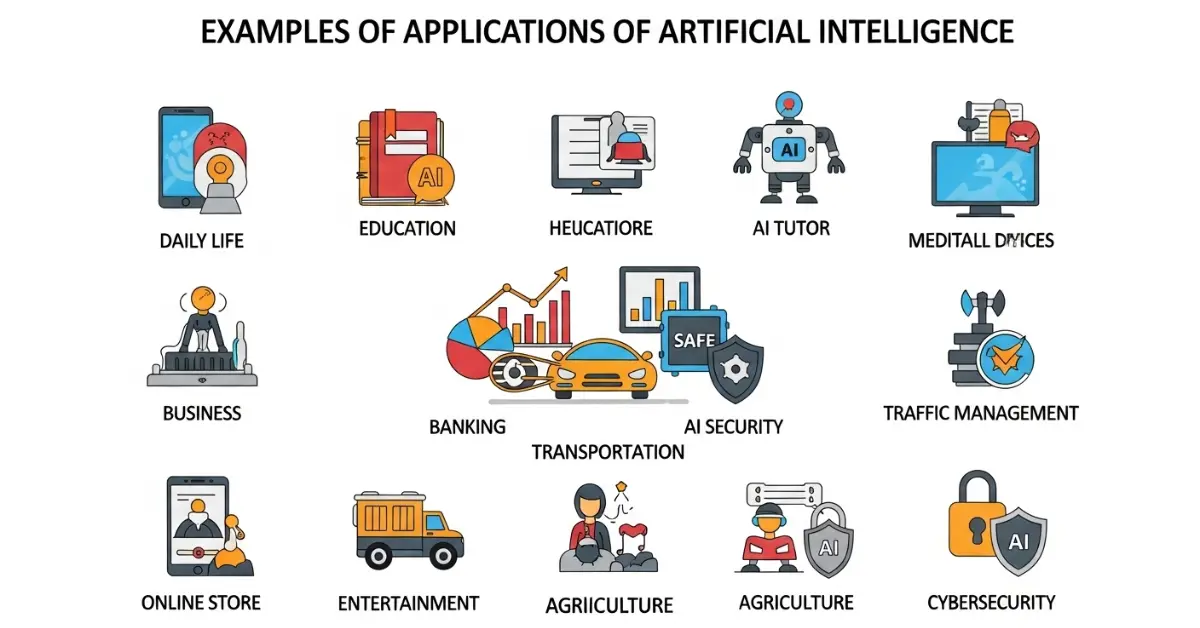
Do people think artificial intelligence only works in robots or big machines? That is not true. AI is closer than many think. It works in phones, apps, websites, and even smart homes. Many people use it daily without realizing it. Studying the examples of applications of artificial intelligence shows how AI touches almost everything in life.
10 Examples of Applications of Artificial Intelligence
Artificial intelligence is now part of many areas in daily life and work. It helps people, businesses, and organizations perform tasks faster, smarter, and more accurately. From learning to healthcare, AI makes life easier in many ways. Here are the main examples of its applications.
10 Examples of Applications of Artificial Intelligence include:
- Applications of AI in Daily Life
- Applications of AI in Education
- Applications of AI in Healthcare
- Applications of AI in Business
- Applications of AI in Banking
- Applications of AI in Transportation
- Applications of AI in Shopping
- Applications of AI in Entertainment
- Applications of AI in Agriculture
- Applications of AI in Cybersecurity
1. Applications of Artificial Intelligence in Daily Life
Artificial intelligence is part of many tools and devices people use every day. It makes tasks easier, faster, and more convenient. Phones, apps, smart assistants, and navigation systems all use AI to help in daily routines.
2. Applications of Artificial Intelligence in Education
AI helps students learn better and teachers teach smarter. It personalizes lessons, checks homework quickly, supports learning apps, and makes classrooms more efficient. AI is changing the way education works every day.
3. Applications of Artificial Intelligence in Healthcare
AI improves healthcare by helping doctors, patients, and hospitals work faster and more accurately. It supports disease detection, medical imaging, virtual health assistants, and robot-assisted surgeries. Healthcare is becoming smarter with AI.
4. Applications of Artificial Intelligence in Business
Businesses use AI to work more efficiently and make better decisions. AI helps in customer support, sales, marketing, data analysis, and inventory management, making business operations faster and more accurate.
5. Applications of Artificial Intelligence in Banking
AI makes banking safer, faster, and easier. It helps detect fraud, approve loans quickly, provide online banking support, and predict financial trends. AI is transforming the way banks serve their customers.
6. Applications of Artificial Intelligence in Transportation
AI is improving transportation by making travel safer, faster, and more organized. Self-driving cars, traffic management systems, navigation apps, and smart parking all use AI to help drivers and passengers.
7. Applications of Artificial Intelligence in Shopping
AI makes shopping smarter and more personal. Online stores use AI to recommend products, create virtual try-on experiences, manage inventory, and assist customers through chatbots, improving the shopping experience.
8. Applications of Artificial Intelligence in Entertainment
AI is changing entertainment by making it more fun and interactive. It helps suggest movies, music, and videos, improves video games, and supports content creation and streaming services to keep users engaged.
9. Applications of Artificial Intelligence in Agriculture
AI helps farmers grow crops more efficiently and sustainably. It monitors soil, predicts yields, detects pests, manages irrigation, and improves overall crop management for better farming results.
10. Applications of Artificial Intelligence in Cybersecurity
AI protects computers, networks, and online systems from threats. It detects cyberattacks, monitors accounts for fraud, verifies identities, filters spam, and improves security in a smarter and faster way.
Advantages and Disadvantages of Examples of Applications of Artificial Intelligence
Here are the main advantages and disadvantages of these examples of applications of artificial intelligence.
10 Advantages of Examples of Applications of Artificial Intelligence
- Makes tasks faster and more efficient
- Provides personalized experiences for users
- Improves accuracy in decision-making
- Saves time for students, teachers, and workers
- Offers 24/7 support with AI tools and chatbots
- Helps monitor health, crops, and security effectively
- Enhances customer experiences in shopping and banking
- Reduces human errors in critical processes
- Helps analyze large amounts of data quickly
- Supports innovation in education, business, and healthcare
10 Disadvantages of Examples of Applications of Artificial Intelligence
- Can be expensive to implement
- Requires reliable internet and modern devices
- May reduce human interaction in work and learning
- Over-reliance can reduce problem-solving skills
- Some AI systems may not fully understand user needs
- Data privacy and security risks
- Technical issues can disrupt tasks
- Not all users adapt quickly to AI tools
- Limited ability to handle creative or complex decisions
- Teachers, doctors, and employees are still needed for supervision
Conclusion
Artificial intelligence is becoming a part of almost every aspect of life. From daily tasks to education, healthcare, business, and cybersecurity, AI helps people work faster, smarter, and more efficiently. It provides convenience, improves accuracy, and supports better decision-making. While there are some challenges like cost, privacy, and technical issues, the advantages of AI are clear.
Overall, the examples of applications of artificial intelligence show how this technology is making life easier, work simpler, and the future brighter.
Frequently Asked Questions About Examples of Applications of Artificial Intelligence
Artificial intelligence is now part of many areas in life and work. Many people have questions about how AI is used in daily life, education, healthcare, business, and more. Here are some common questions and simple answers about the examples of applications of artificial intelligence.
What are the main areas where artificial intelligence is used?
AI is used in daily life, education, healthcare, business, banking, transportation, shopping, entertainment, agriculture, and cybersecurity.
How does AI help in daily life?
AI makes daily tasks easier. It powers virtual assistants, smart apps, navigation, home devices, and recommendations for videos, music, and shopping.
How is AI used in education?
AI helps personalize lessons, provides AI tutors, checks homework, detects plagiarism, and tracks student performance to improve learning.
What are the benefits of AI in healthcare?
AI supports early disease detection, medical imaging, robot-assisted surgery, virtual health assistants, and health tracking devices for better patient care.
How does AI improve business operations?
AI helps businesses with customer support, marketing, data analysis, fraud detection, and inventory management, making work faster and more accurate.
How is AI used in banking?
AI detects fraud, secures online accounts, helps approve loans, predicts financial trends, and provides 24/7 customer support.
Can AI make transportation safer and faster?
Yes. AI powers self-driving cars, traffic management systems, navigation apps, smart parking, and public transport optimization to improve travel.
How does AI improve shopping experiences?
AI recommends products, provides virtual try-on tools, customizes offers, manages inventory, and helps customers through chatbots.
How is AI used in entertainment?
AI suggests movies, music, and videos, improves video games, edits photos and videos, helps create content, and personalizes streaming services.
Can AI help in cybersecurity?
Yes. AI detects cyber threats, monitors accounts for fraud, verifies identities, filters spam, and protects networks and online systems.
